Handwritten vs. Typed Notes: What Science Says (14 Companies Respond)

Handwritten Notes vs Typed: What Science Says About Memory, Learning, and Human Connection
The debate around handwritten notes vs typed is no longer just about preference. It now touches memory, learning, focus, and the way people communicate in a world shaped by digital devices, keyboards, and fast-moving technology. From classrooms to business outreach, the method used to write can influence how information is processed and remembered.
New research in the neuroscience of handwriting shows that writing by hand activates different brain regions connected to cognition, memory formation, and brain function. That is why many experts continue to study handwriting brain activation, note taking, and the difference between handwriting versus typing for students, professionals, and children.
This handwritten notes guide explores the science behind handwritten vs digital communication and why it still matters today. It also shows how brands like SimplyNoted are helping businesses use handwritten notes at scale, combining human connection with modern efficiency.
SEE ALSO: Why Businesses Should Send More Handwritten Notes
Why the Debate Around Handwritten Notes vs Typed Matters
The discussion around handwritten notes vs typed matters because people now rely on screens for almost everything. Students take notes on laptops, professionals use digital tools in meetings, and brands communicate through email, browser-based platforms, and automated systems. Writing by hand has become less common, but that shift has raised important questions about what may be lost when note taking moves fully to digital devices.
Many people compare handwritten vs digital methods because both offer different benefits. Typing is fast, searchable, and easy to organize. It works well for long documents, collaboration, and storing information across devices. Yet handwritten notes slow the process down in a useful way. They require more thinking, more selection, and more active engagement with words and ideas. That difference can affect focus, understanding, and the ability to recall information later.
This is why the choice between handwriting versus typing is more important than it first appears. It does not only shape how notes are recorded. It also influences memory formation, response quality, attention span, and the depth of processing behind each message. In education, that can affect learning. In business, it can affect how a message feels. In both cases, the difference between handwritten notes and typed text goes beyond convenience.
The Neuroscience of Handwriting and Brain Activation
The neuroscience of handwriting helps explain why writing by hand feels different from typing, even in thank you cards. When a person writes with a pen, the brain is not only choosing words. It is also guiding movement, recognizing letter shapes, controlling pressure, and connecting visual input with physical action, rather than relying on keyboards and other such devices.
Researchers studying handwriting brain activation often point to the motor system, visual system, and other brain areas involved in learning and cognition. Handwriting engages different brain regions linked to letter recognition, memory, and brain function. Writing letters by hand, including thank you cards, creates more sensory and movement-based information to process.
This is one reason handwriting appears to support stronger mental engagement. The brain activity involved in handwriting is more varied and connected than typing, because the hand, the eye, and the brain work together in a coordinated process.
What Research Says About Handwriting Memory Retention
A growing body of research suggests that handwriting memory retention is one of the strongest reasons to choose pen and paper in certain situations, including a Custom Handwritten Card. Students tend to remember ideas better when they write notes by hand because the process forces them to think about what matters and connect it with prior knowledge.
Instead of copying every word, they usually summarize, interpret, and shorten information. That extra mental effort supports stronger memory formation. Research often shows that students wrote better summaries by hand, while typed note taking encouraged faster transcription but less reflection.
This matters for university students, college students, and other learners. Handwriting versus typing changes how the brain interacts with content, influencing recall, comprehension, and learning outcomes.
Handwritten vs Digital for Note Taking and Learning

The comparison between handwritten vs digital note taking is especially important in classrooms, meetings, and study sessions. Digital tools make it easy to store, search, and share notes. They also help when speed matters. A laptop or tablet can be useful for long lectures, fast discussions, or collaborative work. For organization and convenience, digital devices clearly offer value.
Still, handwritten notes often support better learning when understanding matters more than speed. Taking notes by hand requires a person to slow down and make choices. That means selecting key ideas, shortening explanations, and putting concepts into simpler language. This process helps the brain focus on meaning rather than just capture. In many cases, that leads to deeper understanding and better recall later.
Typed notes can be helpful, but they sometimes make it easier to record information without fully processing it. That is where handwritten vs digital becomes more than a technical preference. It becomes a question of learning quality. In many study settings, writing by hand strengthens attention, supports memory, and improves the ability to connect ideas. Digital note taking is useful, but handwritten notes remain powerful because they demand more thinking during the learning process.
Handwriting vs Typing in Early Childhood Development
The difference between handwriting and typing is even more important in early childhood. Preschool children and young learners are still developing motor control, letter recognition, and the brain systems used for reading and writing. During this stage, handwriting training does more than teach children how to make letters. It helps build the foundation for language, coordination, and learning.
Handwriting activities support development because they connect movement with visual recognition. When children write letters by hand, they learn the form of each symbol through repeated physical action. This strengthens recognition of words and shapes while also improving fine motor ability. The motor system and visual system work together in a way that typing does not fully reproduce. Pressing keys is simpler, but it does not require the same detailed control or awareness of letter structure.
This is why handwriting appears to offer unique benefits in early childhood education. Writing by hand can help children understand how letters are formed, how words are built, and how symbols connect to language. While technology has a place in modern learning, handwriting practice remains important for young students because it develops both brain function and physical skill at the same time.
SEE ALSO: How to Impact People With Handwritten Cards
Handwritten vs Printed Mail in Business Communication
The discussion around handwritten notes vs typed also matters in business communication. Companies send printed mail, email campaigns, and automated messages every day. These methods are efficient, but they often feel generic. In contrast, handwritten vs printed mail creates a very different response because the format itself signals care, effort, and intention.
A handwritten note feels personal in a way that typed or printed communication usually does not. The pen strokes, spacing, and natural variation make the message feel connected to a real person. That matters in customer experience because people respond to effort. A printed message may be clean and professional, but it can also feel mass-produced. A handwritten note often creates warmth, trust, and stronger emotional impact.
This difference can influence brand recall, response rates, and relationship building. In sales, follow-up, gifting, and customer retention, handwritten notes can make people feel noticed rather than processed. That is why businesses continue to invest in handwritten communication. Services like SimplyNoted help brands use handwritten notes at scale without losing the human quality that makes them effective. In a crowded digital environment, handwritten mail stands out because it feels rare, thoughtful, and real.
Why Handwritten Notes Create a Stronger Human Connection
Handwritten notes create a stronger human connection because they show visible effort. A typed message can be sent in seconds, copied easily, and repeated across hundreds of recipients. A handwritten note feels different because it carries the marks of a person’s time and attention. That small difference can change how the message is received.
The form of the writing, the movement of the pen, and even slight imperfections can signal authenticity. Handwriting appears more sincere because it is harder to fake emotional effort through it. People often interpret handwritten communication as more thoughtful, more deliberate, and more personal. This is true in thank-you notes, apology messages, direct mail, and client follow-up. The physical look of handwriting adds emotional weight in a way that typed text often cannot match.
That is why handwritten notes remain powerful in both personal and professional settings. They do not just deliver words. They deliver presence. In a digital world full of fast messages and automated systems, a handwritten note feels like proof that someone stopped, thought, and chose to connect in a more meaningful way. That human quality is exactly why handwritten communication continues to matter.
When Typed Notes Still Make Sense
A fair comparison of handwritten notes vs typed should also recognize where typing works better. Typed notes are faster to create, easier to edit, and much simpler to store across digital devices. In fast meetings, live lectures, and collaborative work, a computer or other devices can help capture more information in less time. That speed is useful when the goal is documentation rather than deep processing.
Typed notes also offer practical benefits for search, sharing, and organization. A person can use a browser, cloud platform, or note-taking app to find information quickly, move content between pages, and collaborate with teams in real time. For businesses, typed communication is also easier to scale across departments, campaigns, and customer support systems. Technology makes it possible to manage huge amounts of information efficiently.
The key point is not that typing is bad. It is that typed and handwritten methods serve different purposes. If speed, storage, and convenience matter most, typing often wins. If memory, focus, and personal connection matter more, writing by hand often has the advantage. The best approach is understanding the difference and choosing the right method for the task.
SEE ALSO: When You Should Send Out Cards
How Businesses Are Turning Handwriting Science Into Results

The science behind handwriting memory retention and human connection is not only interesting for researchers. It has also created real business opportunities. A growing body of companies now build products and services around the proven value of handwritten communication. This shows that the benefits of handwriting are not just academic ideas. They are being used in real marketing, customer retention, and relationship-building strategies.
Brands in this space include SimplyNoted, Handwrytten, Scribeless, IgnitePost, PostPilot, Postable, Levitate, Letter Friend, and even Etsy sellers offering personalized handwritten-style products. Each one reflects the same larger idea: people respond differently to handwritten notes than they do to standard printed mail or digital outreach. Businesses have recognized that handwriting appears more authentic, more thoughtful, and more memorable in a crowded market.
This trend matters because it confirms the practical value of handwritten notes vs typed communication. If handwriting had no real-world effect, companies would not continue building services around it. Instead, businesses across industries use handwritten outreach to improve customer experience, strengthen trust, and stand out from repetitive digital noise. The science and the market are pointing in the same direction.
Why SimplyNoted Stands Out in the Handwritten Notes Space
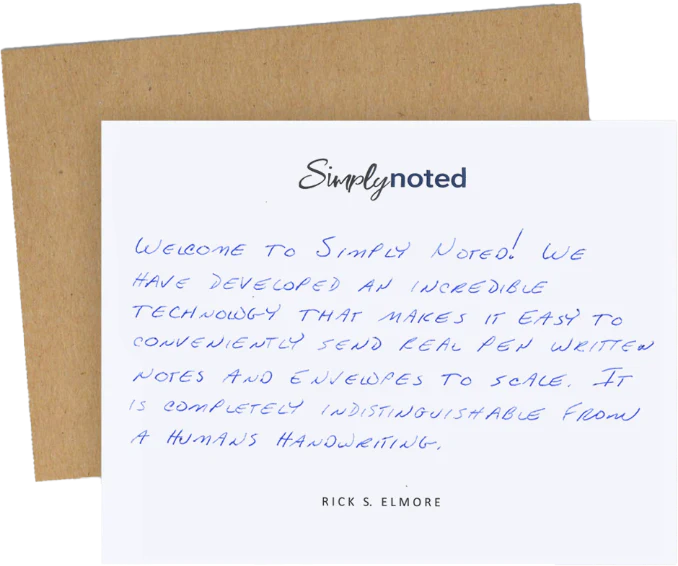
Among the companies using this model, SimplyNoted stands out because it helps businesses scale handwritten notes without losing the personal touch that makes them effective. Many companies want to send more thoughtful follow-ups, thank-you notes, and retention messages, but they do not have time to write every note manually. SimplyNoted solves that problem by making handwritten outreach practical for modern teams.
This matters because most brands already rely heavily on email, text, and automated workflows. Those channels are useful, but they are also crowded and easy to ignore. A handwritten note arrives differently. It feels personal, intentional, and worth opening. SimplyNoted helps brands use that advantage in a structured way, making it easier to build relationships instead of sending one more forgettable digital message.
For businesses that care about customer loyalty, referrals, or meaningful follow-up, SimplyNoted offers a strong bridge between human connection and modern efficiency. It brings the science of handwriting into real business use. That makes it more than a novelty. It becomes a strategic tool for companies that want their communication to feel more real.
Best Use Cases for Handwritten Notes in Modern Marketing
Handwritten notes work best when the goal is to create trust, appreciation, or emotional impact. One of the strongest use cases is the thank-you note. After a purchase, consultation, or meeting, a handwritten message can leave a lasting impression that strengthens the relationship. It shows effort in a way that automated follow-up rarely does.
They are also highly effective for customer retention and referral outreach. A business can thank loyal clients, reconnect with inactive customers, or acknowledge referrals with a message that feels personal rather than promotional. In these moments, handwritten vs printed mail often makes a noticeable difference because the message feels more sincere. This can improve response rates and help customers remember the brand.
Other strong use cases include event follow-up, lead nurturing, employee appreciation, and gift-related communication. In each case, the note works because it breaks the pattern people expect. Most people receive endless typed communication every day. A handwritten note changes the experience. It slows the interaction down and gives the message more weight.
Handwritten Notes Guide: How to Use Them Effectively

A good handwritten notes guide starts with one simple rule: keep the message personal and specific. A note should not feel like a generic script copied onto paper. It should mention something real, whether that is a purchase, a conversation, an event, or a reason for appreciation. The more relevant the message feels, the stronger its effect.
Timing also matters. A thank-you note sent soon after a meeting or order feels thoughtful because it connects to a recent experience. Waiting too long can reduce the emotional impact. The same applies in business follow-up. Handwritten notes work best when they feel timely, intentional, and connected to a clear moment in the relationship.
It is also possible to combine handwriting with modern tools. Some businesses use digital handwriting, an Apple Pencil, or specialized platforms to create a handwritten effect while improving efficiency. The goal is not to reject digital tools completely. It is to use them in a way that preserves the emotional value of writing by hand. That balance is where modern handwritten outreach becomes most effective.
SEE ALSO: How to Write a Thank You Note - Best Tips and Examples
Final Verdict on Handwritten Notes vs Typed
The comparison between handwritten notes vs typed is not only about speed or convenience. It is about how the brain works, how memory forms, and how people respond to communication. Research into the neuroscience of handwriting shows that writing by hand activates different brain regions tied to learning, cognition, and recall. That helps explain why handwritten notes often support stronger memory retention and deeper understanding.
The difference also matters outside the classroom. In business communication, handwritten notes often create more trust, stronger emotional impact, and better relationship-building than standard typed or printed messages. They feel rare in a world dominated by screens, and that rarity gives them power. When people see handwriting, they often see effort, authenticity, and attention.
Typed notes still have clear advantages, especially for speed, search, and collaboration. But when the goal is meaningful learning or meaningful connection, writing by hand continues to offer unique benefits. That is why handwritten communication still matters today, and why businesses are continuing to invest in it.
Turn appreciation into something people remember. Browse SimplyNoted’s Custom Thank You Cards and send handwritten notes that feel thoughtful, personal, and real.
FAQs: Handwritten Notes vs Typed
1. Are handwritten notes better than typed notes for memory?
Yes, evidence and data suggest handwritten notes can improve memory formation. Research from Norwegian University studies by Audrey van der Meer and work discussed by other experts, including examples cited by Vanderbilt University, show stronger brain activation.
2. Why does handwriting help the brain more than typing?
Handwriting can enable deeper processing because it engages motor, visual, and language systems together. Van der Meer’s research and other experts suggest this helps determine how the brain stores words, ideas, and learning more effectively than typing.
3. Is handwritten vs typed important for students?
Yes. In many cases, students using handwritten notes process ideas more actively instead of copying everything. Evidence, data, and example findings linked to Vanderbilt University and Norwegian University show benefits for focus, learning, and recall.
4. Can businesses benefit from handwritten notes over typed messages?
Absolutely. Handwritten notes often feel more personal and memorable than typed outreach. That is why experts like Vinci Booher and brands in this space highlight handwriting as a way to enable trust, strengthen response, and improve human connection.